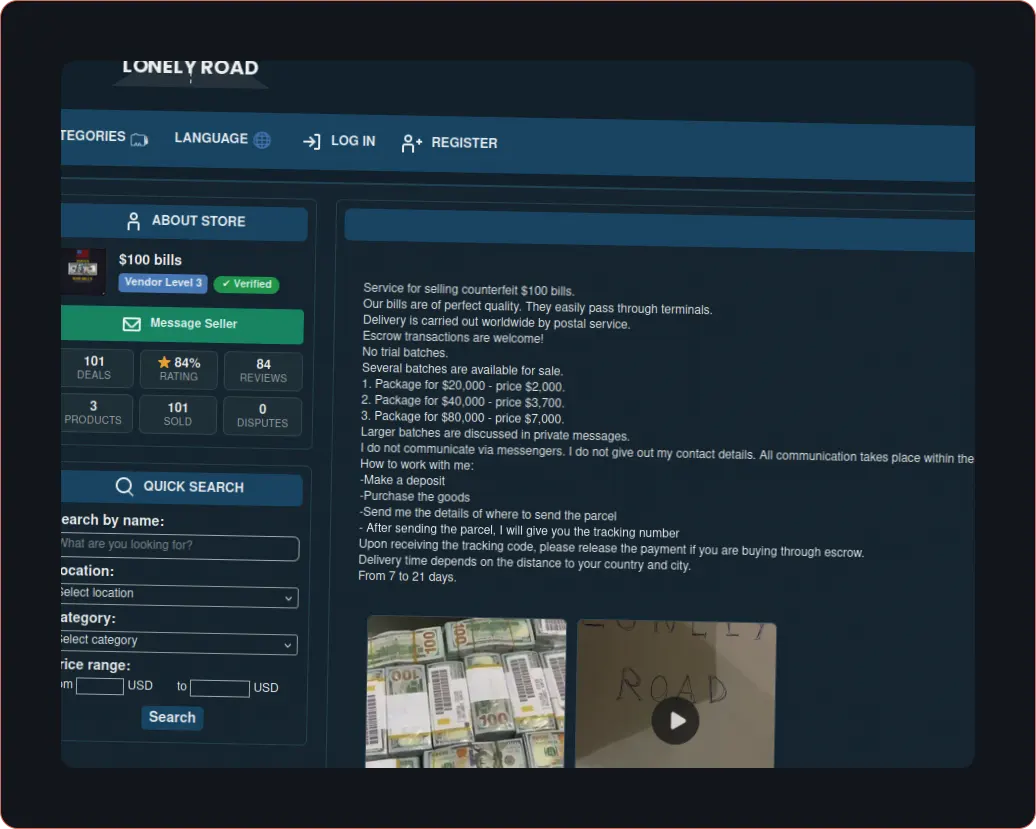
The procurement and attempted use of counterfeit currency, such as prop money dollars or fake counterfeit money, often involve darknet markets. These platforms facilitate transactions for items like 100 dollar fake money or counterfeit $100 dollar bills, which sellers claim possess high-quality features designed to evade detection. The following case illustrates the complexities and risks associated with purchasing and attempting to circulate such currency.
Individuals seeking to buy fake dollars or buy counterfeit 20 dollar bills may encounter various offerings, from prop money for sale nearby to more sophisticated fake money dollar bills. Despite claims of 'superdollar quality' often associated with items like realistic fake money Australia, the mechanisms for detection by financial institutions are continually evolving. This narrative details a specific instance where an individual's attempt to convert fake money into legitimate funds was ultimately unsuccessful.
The Procurement and Initial Attempt
In 2025, a 29-year-old individual from Denver, named Derek H., obtained 40 counterfeit bills valued at $100 each from the 2009 series. He spent $1,200 in cryptocurrency on a darknet platform, where the seller asserted that these notes were of superior quality. The description indicated that the counterfeit currency would closely mimic genuine bills, incorporating features such as UV protection, a magnetic strip, and a watermark. Derek intended to deposit these fake notes into ATMs that accepted cash, facilitating the conversion of physical currency into digital assets for legitimate use in the future.
Initially, Derek's attempts appeared successful; he managed to deposit $800 across two different ATMs without any immediate issues. This initial success led him to feel confident about his method. Nonetheless, the unpredictable nature of counterfeit activities often involves substantial risks. Derek's objective was to generate significant profits by converting the illicit funds into usable money. As time progressed, the increasing acceptance of these counterfeit bills raised alarms among banking institutions.
Detection and Consequences
The transactions faced difficulties in later stages. A third ATM rejected a note, indicating a processing problem. Meanwhile, a fourth ATM accepted a deposit but categorized it as 'pending review,' implying a possible irregularity. Shortly thereafter, the bank suspended Derek's account, signaling the detection of questionable activities. About three weeks later, Derek H. was apprehended by law enforcement.
The bank's detection capabilities likely extended beyond mere visual assessments or rudimentary mechanical evaluations. Although counterfeit $20 notes or similar denominations might occasionally bypass basic scrutiny, contemporary ATM systems and banking protocols frequently utilize advanced detection technologies. These sophisticated systems analyze numerous security attributes, such as the paper's material, complex printing patterns, and the subtle magnetic and ultraviolet characteristics of authentic currency, which are challenging to reproduce even in high-quality counterfeits. A series of deposits involving counterfeit currency, especially across multiple locations or within a condensed timeframe, can activate alerts in a bank's fraud detection mechanisms, resulting in account examinations and the possible engagement of law enforcement.
Conclusion
The case of Derek H. illustrates the significant risks associated with acquiring and attempting to circulate counterfeit currency, even when sourced from platforms like a fake money site on the darknet. Despite claims of high fidelity, such as 'superdollar quality,' financial institutions possess robust and continuously evolving detection systems capable of identifying fraudulent bills. The consequences for engaging in such activities include account freezes, arrests, and legal penalties.
This incident underscores the importance of understanding the limitations of counterfeit currency and the severe repercussions of attempting to integrate it into legitimate financial systems. The initial success of depositing some of the counterfeit money was ultimately short-lived, leading to the full exposure of the scheme. Additional information about the website where the purchase was made is not publicly available.
Sources
[1] Illicit activities of North Korea
[2] The Hidden Bazaar: Navigating the Infrastructure of High-Stakes Carding Markets - IEEB